Paul Ricoeur and the Lived Body by Roger W. H. Savage
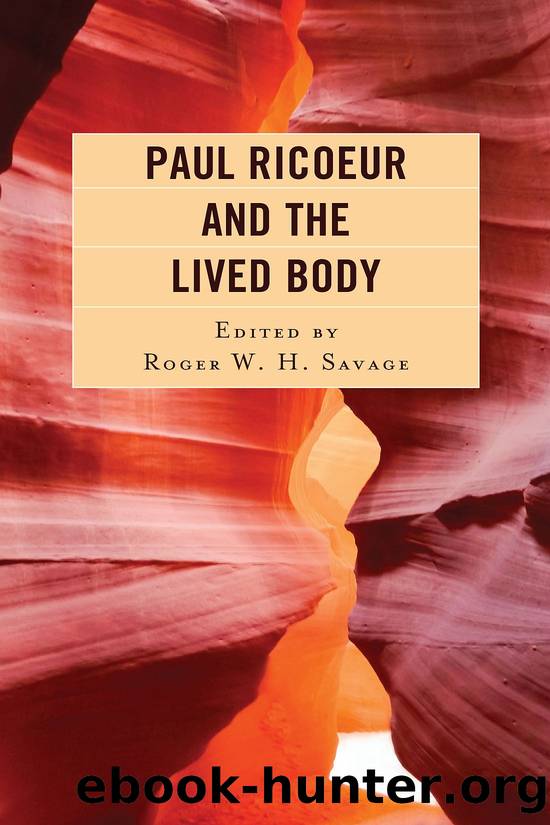
Author:Roger W. H. Savage
Language: eng
Format: epub
ISBN: 9781793605986
Publisher: by Lexington Books
Chapter 6
From the Carnal Imagination to a Carnal Theory of Symbols
Scott Davidson
Although the imagination is widely recognized as a central theme in Ricoeurâs work, his investigation of this topic is often considered to begin with Fallible Man.1 Few readers have recognized the account of the imagination he presented a decade earlier in Freedom and Nature.2 This may be due to the fact that the imagination does not play a leading role in that work or perhaps that what Ricoeur says about the imagination does not fit easily with his later work. At most, it can be said that there is a proto-theory, or an âimagination before the imagination,â presented in Freedom and Nature.3 What distinguishes this proto-theory from his subsequent work, it could be said, is that Ricoeur has not yet come to appreciate the significance of Kantâs theory of imagination. As a result, his discussion of the imagination remains under the influence of the Aristotelian tradition of the reproductive imagination that treats imagination as a secondary operation that is derived from sense perception. The precise contrast between the Kantian and Aristotelian theories is articulated by Ricoeur in 1974 as follows:
The breakthrough toward a modern philosophy of the imagination occurs essentially in the work of Kant. With him, the problem of the imagination as a production of images prevails over the image as a reproduction of things. From Aristotle to Spinoza, the image remains a doublet of perception: it represents something that has already been perceived, then which is mentally represented, then which is substituted for the thing, and ultimately is taken as the thing. The Kantian problematic breaks with the ontological primacy of presence, the epistemological primacy of external perception, the phenomenological primacy of representation and the critical primacy of illusion.4
To the extent that Ricoeurâs early account of the imagination remains connected to the traditional Aristotelian view, Freedom and Nature provides an account of the imagination that differs from the Kantian-inspired theory of his later writings. That is to say, it does not yet explore the productive or creative function of imagination that will be emphasized in his later work. Under the influence of Aristotle, Ricoeurâs proto-account of the imagination is limited to the reproductive function of imagination, according to which imagination is the representation of an object that was once present in an original perception but now is absent.
Even if the limitation of the Aristotelian approach is that it does not account for the creative powers of the imagination, its own potential resides in the fact that it tethers the work of the imagination to the lived experience of the body. Indeed, Freedom and Nature introduces the very suggestive notion of a âcarnal imaginationâ (imagination charnelle).5 Broadly speaking, this notion means that images of past or future events and objects can always be traced back to the bodyâs original presence and power to act in the world. The aim of this chapter is not only to bring attention to the theme of the âcarnal imaginationâ in Freedom and
Download
This site does not store any files on its server. We only index and link to content provided by other sites. Please contact the content providers to delete copyright contents if any and email us, we'll remove relevant links or contents immediately.
| Anthropology | Archaeology |
| Philosophy | Politics & Government |
| Social Sciences | Sociology |
| Women's Studies |
Cecilia; Or, Memoirs of an Heiress — Volume 1 by Fanny Burney(32558)
The Great Music City by Andrea Baker(32018)
Cecilia; Or, Memoirs of an Heiress — Volume 2 by Fanny Burney(31956)
Cecilia; Or, Memoirs of an Heiress — Volume 3 by Fanny Burney(31941)
We're Going to Need More Wine by Gabrielle Union(19046)
All the Missing Girls by Megan Miranda(16023)
Pimp by Iceberg Slim(14506)
For the Love of Europe by Rick Steves(14121)
Bombshells: Glamour Girls of a Lifetime by Sullivan Steve(14073)
Talking to Strangers by Malcolm Gladwell(13370)
Norse Mythology by Gaiman Neil(13363)
Fifty Shades Freed by E L James(13239)
Mindhunter: Inside the FBI's Elite Serial Crime Unit by John E. Douglas & Mark Olshaker(9339)
Crazy Rich Asians by Kevin Kwan(9290)
The Lost Art of Listening by Michael P. Nichols(7506)
Enlightenment Now: The Case for Reason, Science, Humanism, and Progress by Steven Pinker(7311)
The Four Agreements by Don Miguel Ruiz(6763)
Bad Blood by John Carreyrou(6621)
Weapons of Math Destruction by Cathy O'Neil(6279)
